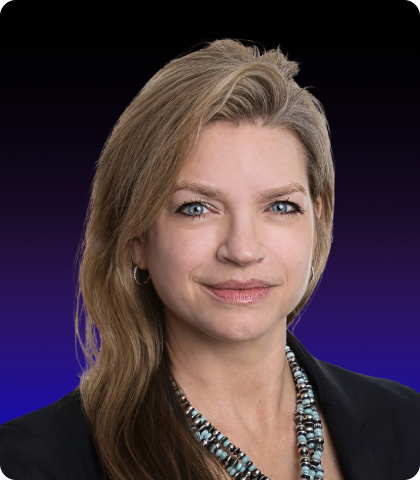


The CEO, Lloyd’s Americas and Chief Commercial Officer, Lloyd’s explains why collaboration beats isolation, how AI helps close protection gaps, and why capital needs transparency to take on climate risk
When Dawn Miller thinks about the impediments to driving meaningful insurance innovation, the image is specific: It’s when a company assembles a small group of tech mavens, and cloisters them far apart from the organization’s other departments where “they do special things.”
She’s seen this pattern repeat across her 25 years in the industry, through leadership roles at Chubb, AXA, AIG, and WTW, across cities from Washington to London to Dubai to San Francisco. Innovation teams isolated from core operations. Technology solutions developed without understanding the actual business problems. Founders building products in a vacuum, then wondering why the market won’t adopt them.
The challenges ahead are too large for that approach, Miller argues. Climate risks that don’t fit traditional peak peril models. Cyber protection gaps that leave SMEs vulnerable. Data deficits that prevent proper pricing of emerging exposures. These problems demand something different — minds coming together, diverse thoughts colliding, “people willing to push and pull ideas with the courage to fail fast.”
Since joining Lloyd’s in 2022 and taking on dual roles as Chief Commercial Officer and CEO of Lloyd’s Americas this past September, Miller has worked to embed that collaborative philosophy into how the market approaches innovation.
Her approach is manifested in initiatives like the Lloyd’s Lab. Now in its “16th cohort,” Miller is working to demonstrate that innovation can’t be siloed if it’s going to solve problems whose contagion effects are likely to spread more swiftly and unpredictably than anything insurance professionals have encountered previously.
The Insurance Lead spoke with Miller about how Lloyd’s translates that philosophy into practice, why the industry’s data gaps around climate risk are more urgent than most realize, and what it takes to make innovation stick rather than remaining a demonstration that never scales.
The Insurance Lead: At InsurTech Insights you emphasized that innovation can’t be siloed — it must be integrated into the core business. How does that philosophy manifest in how Lloyd’s Lab actually operates?
Dawn Miller: I truly believe that innovation only happens when people are collaborating with each other, when they are in an environment that allows them the courage to fail fast, to exchange ideas and be open to shaping and reshaping them together. It can be a way of processing data, certain analytics, a certain skillset – but ultimately, it involves the pushing and pulling of how that data can be applied to the industry.
What doesn’t seem to work in our industry is treating innovation as something siloed – when it’s regarded as “Oh, innovation is handled by a special group over there and they do special things.” Innovation has to happen when minds are coming together and diverse thoughts are coming together to challenge, because the challenges we’re seeing ahead of us now are so large. I see it as the ability for a contagion effect around large challenges, and how those contagions will unfold much faster than they may have in the past.
From a Lab perspective, we have the accelerator within Lloyd’s that’s been running for six years now. We’re currently on cohort number 16. We do two cohorts a year across 10 weeks, with anywhere from 12 to 15 participants. They come in with multiple mentors from all disciplines within the insurance industry, and they’re able to push and pull, curate and refine their product or service.
They come out of that accelerator ideally with a proof of concept project, which we help them facilitate into the market, or capacity from a risk taker. Then we curate the alumni community as well. We also have an accelerated pathway for some of these products into becoming coverholders with special risk codes to allow these products to be underwritten in the marketplace.
We’re trying to cover the bases of helping these businesses accelerate and helping them find a landing in the market.
How do you ensure the Lab’s cohorts are addressing actual market needs rather than just interesting technology?
Each cohort that comes in has specific themes that generally have three to four calls to action. They tend to be either specific product and analytics needs, or they could be around cyber risk management, resilience or reinsurance issues, or AI computing capabilities. The Lab is very purposeful about the calls to action we bring so that we can bring specific solutions to the marketplace.
We often team up with other government bodies, other market participants, and other organizations around the world to develop initiatives with a clear geographic focus.
Then it’s a three-to-four-tier process for entry into the Lab, with the market — who we see as our clients – engaged all the way along. There’s an initial screening , then blind voting across in a very deliberate, intentional, data-driven fashion with as many market participants as want to participate. Then there’s a pitch with the market participating in voting, and then we determine a final list.
You’ve identified climate risk, AI, and cyber as the top concerns for underwriters. Which of these three do you believe Lloyd’s — and the broader market — is least prepared for?
Every year, each of our managing agents prepares their own risk solvency assessment that allows them to bring to surface their main challenges and risks ahead. We aggregate that into a master report for our marketplace. You’re right — cyber, AI, and geopolitical risk are at the top of the list. Talent is often there as well.
On the cyber front, everyone is concerned about what a large-scale contagion cyber episode could look like. We’re trying to prepare for that and make sure insurance policies are as watertight as possible, and we’re clear where state-sponsored cyber coverage is covered or not. But the cyber piece that really concerns everyone is the protection gap.
It’s still a relatively new product, though not as new as it used to be. It’s still very challenging to sell. It’s still viewed as a discretionary spend. The SMEs [small-to-medium-sized enterprises] just need something to get to the next day. It’s still not being seen as one of those things you have to get, just like your property or GL or your workers’ comp. Creating that awareness, particularly in developing economies, is critical.
AI is looked at from the perspective of: how is it sitting within our products today, and are we clear about how we’re covering it or not? That differs between financial lines, property, GL, and otherwise. So there’s product risk and opportunity in that.
Where do you see AI creating the most impact beyond product coverage questions?
If you takeaway how we’re all using it to improve our own internal operational processes, the place we’re seeing AI create the most impact is that opportunity to aggregate data more effectively. For the most part, we’re using AI to chew through data, to create a richer database to assess risk from.
And that may even enable us to reach more risks, because you’ve done that more rapidly. You’ve taken away some of that work so that your underwriting expertise and human capital can be used on assessing more risks and taking more risk, and therefore closing that protection gap.
There’s considerable concern about AI’s impact on jobs, particularly for entry-level roles. How does Lloyd’s approach that tension?
I do not believe that AI is going to replace all of our jobs. I believe that it is there to enhance the roles that we’re doing. The people that are going to be successful going forward are those that learn how to use AI.
What goes into AI is only as good as what we put in – only as good as how we prompt it, and only as good as how educated we are in prompting it to deliver data, insights and analytics that we then enrich through our own human minds.
Yes, there are some roles that will not be as relevant. So when it comes to the individuals who would’ve done those roles, the question we have to ask is, How are we working with them? Let’s work with them to educate in a different way so they do even more fulfilling roles going forward, empowered by what the AI has given them.
Will it change the workforces around us? Absolutely. Will it get rid of the workforces around us? No. But we do need to deal with how to work side by side with an AI workforce.
You mentioned climate as another major challenge. Where specifically is the industry struggling?
Think about what traditionally were some of our peak perils, which are things we know well. We know earthquakes, we know hurricanes. We know where those potential issues are going to come up in Japan, in the United States. We follow those.
Where we are less adept are severe convective storms, hail, and inland flooding. These are things that seem like they’re on a one-off basis, small storms here and there. But they’re adding up in such a way that it’s catastrophic when you look at the global insurance industry as a whole.
And we don’t have the data. The industry doesn’t have the data, and the industry openly acknowledges this gap.
Here’s a great example for the concept of innovating together: creating a baseline, a common language, a common taxonomy to address some of these issues. Because we don’t have time. The climate and the earth is changing around us, and the storms we’re seeing today are not the storms we saw in the past.
How does AI fit into solving the climate data challenge?
There’s a huge opportunity for AI to help us in the world of modeling. It involves bringing the ability to bring greater computing power into some of the analytics that we need to do.
And then that can help us answer: How do we create climate-resilient housing? So you can start dealing with some of the housing affordability issues. You have populations that live in climate risk zones, and that’s not going to change. They’re not going to be able to migrate somewhere else.
How are we working between our industry, regulators, comfort with AI, comfort with new technology, to create an environment where we can shift regulation where it makes sense so you can more rapidly build in a more resilient fashion? It all kind of links together in a way that we’ve never seen before.
Lloyd’s has been around for over 300 years. There’s a perception that it’s still quite London-focused. What are you doing to change that narrative?
On the one hand, I’m incredibly proud and honored to be in an organization that has the heritage of Lloyd’s. It’s really quite extraordinary. The more you learn, the more you dig through, it’s incredible what we’ve created for the industry and what we continue to inspire every day.
At the same time, we have to recognize that one of the greatest assets of Lloyd’s is our global reach: we have 80 insurance licenses and the capability to write reinsurance business in over 200 territories. This means we need to look farther than just the UK.
We’re really working hard on our narrative to make sure that we are viewed — yes, we are based out of the UK and super proud of that heritage — but we are contributing significantly to the economies that we operate in.
We’re a significant contributor to the U.S. economy, providing $20.8 billion in surplus lines insurance capacity in 2024 alone – which accounted for 16% of the excess and surplus marketplace. We’re also an increasingly important contributor to the economies of Asia Pacific, Middle East, and Africa — about $10 billion now.
And it’s not because there’s something so special about us. Yes, we’re incredibly special, but it’s because what you’re seeing is a desire for risks to stay, to be placed closer to home.
You’re seeing an increase in risk-taking capital looking at some of these emerging areas. And you’re seeing an intersection of underwriting capability able to handle those complex risks.
It’s all coming together, and we’re super proud of what we’re working on at Lloyd’s — making sure we take the best of the UK Lloyd’s heritage and weave that into local narratives around the world.
Given the protection gap crisis in states like California, Florida, and Texas, what role does Lloyd’s play in addressing housing affordability and insurance availability?
What’s important is that risk-taking capital has to be paid for the risk it takes. Capital taking risk has choices — it could invest in brain surgery, it can invest in building houses, it can invest in insurance.
It has to understand and be there for the long haul and want to take that risk. The more that we create transparency about the risk being taken, the more that there’s data, the more those single-family homes in the Midwest, as an example, are made resilient — the more insurance protection available. And then the housing, or whatever the topic may be, becomes affordable and accessible.
Capital has choices, and it needs to be able to understand that it can exercise those choices. We’re constantly curating in our marketplace, and I know other insurance marketplaces around the world are doing the same, to create innovative new vehicles so that more risk-taking capital can attach to some of these really hard challenges. We’re seeing that play out in the ILS market.
You’ll be speaking at InsurTech Insights again this year. How has your message about innovation evolved?
I think part of the journey I’m hopeful to talk about is how we’re seeing the impact of some of these technologies. Whisker Labs is a great example — we’re seeing innovations where they came in to solve a problem and are now being deployed at scale across the United States in a way that makes risk-taking, risk prevention, and risk preparedness digestible and accessible for all.
That’s all we can hope for in our industry, because we are trying to do what we can to mitigate the challenges around us. Seeing a lot of these innovations now really stick is great to see.