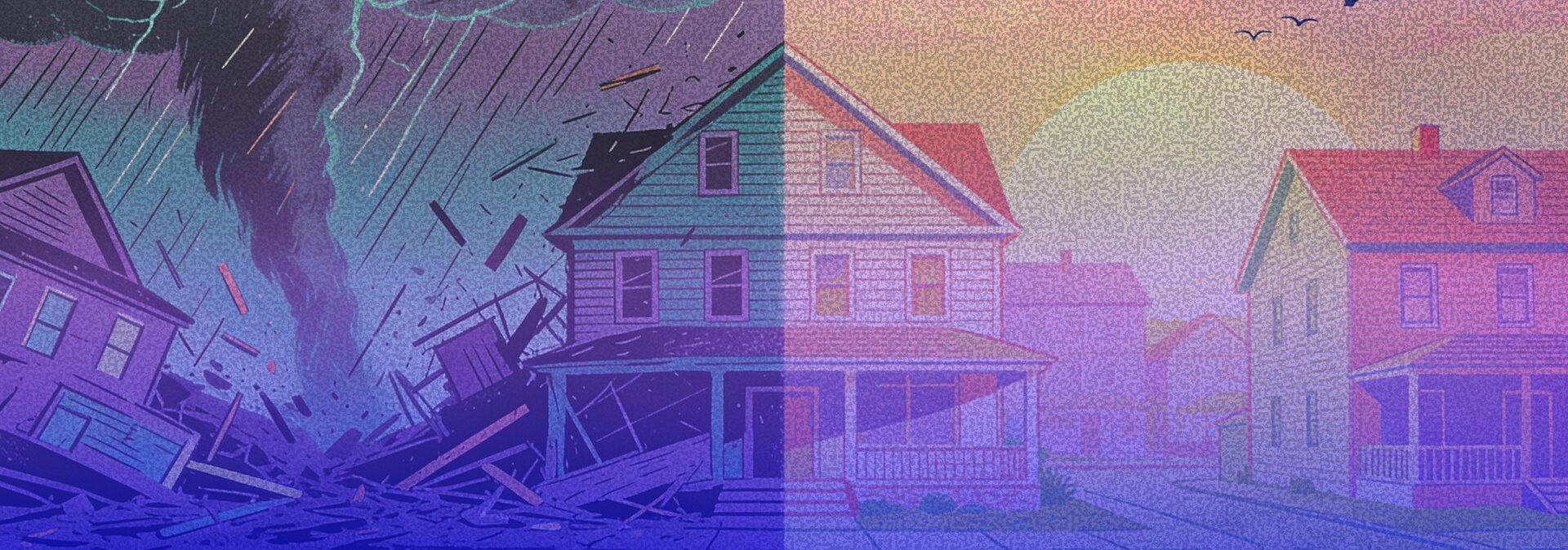

The industry has spent decades optimizing underwriting, pricing, and claims. But the moment that matters most to policyholders—the moment of loss—remains structurally broken.
The insurance industry doesn’t lack sophistication. We’ve built extraordinarily complex pricing models, refined underwriting workflows, and invested billions in claims automation. But we’ve optimized around validation, not velocity. And when a climate event or natural catastrophe occurs, that choice shows its costs.
After a major storm, the indemnity process requires physical loss adjustment. For individual losses, that works. But when climate events become widespread — when severe convective storms impact entire regions, or when flooding affects multiple states simultaneously — time consumed by the adjustment process creates a liquidity crisis for the people who need timely help the most. Small businesses can’t make payroll while waiting for assessors. Homeowners facing rising deductibles can’t access capital to stabilize their properties before secondary damage sets in.
We’ve designed the moment of loss around our operational requirements, not around the financial reality policyholders face when disruption occurs.
The Problem Has Shifted Faster Than the Product
In 2005, hurricanes represented some of the largest aggregate losses in the country. That’s no longer true. Severe convective storms—tornadoes, hail, flooding—now outpace episodic hurricanes from a total dollar perspective. Not because any single event is catastrophic, but because 500 events over a period of time create massive aggregation.
As I was writing this, a third of the country sat under severe convective storm warnings simultaneously. That scale of simultaneous exposure wasn’t normal a decade ago. It is now. And these storms are migrating eastward from what we used to call central U.S. “Tornado Alley” into regions with different building codes, different infrastructure resilience, and different policyholder expectations.
Traditional policies weren’t built for this. They were built for physical loss adjustment at a controllable pace, not for systemic velocity where liquidity determines whether a small business survives or a homeowner can prevent compounding damage.
The coverage gaps are structural. Unless you have physical damage at your location, you don’t have business interruption coverage—even if a climate event makes your business inaccessible to customers, disrupts your supply chain, or prevents critical suppliers from servicing you. Homeowners don’t have coverage for docks, decking, seawalls, landscaping, or pool equipment in wind zones. These aren’t edge cases. They’re an untransferred risk that policyholders retain, often without realizing it until the event occurs.
We’re underwriting risk faster than we can make policies resilient to it.
From Reimbursement to Real-Time Response
This says more about traditional insurance infrastructure than it does about parametric products. Traditional policies—ISO forms, AAIS templates—don’t keep pace with change by design. The industry isn’t leading edge or bleeding edge. It’s meant to be a lubricant that pools risk over time, which creates stability but also creates lag.
That lag used to be acceptable. It isn’t anymore.
The solution comes with embedding parametric features directly into traditional policies; this updates the infrastructure to respond to the world as it exists today, not as it existed when the policy forms were written. Rather than thinking about reinventing indemnity coverage on a wholesale level, I’m thinking about ways we can layer immediate, objective liquidity on top of it so that when an event occurs, policyholders receive certainty and speed where it matters most—at the exact moment disruption happens. This helps close the gap between economic loss and insured loss—a gap that organizations like the Insurance Information Institute have documented widening significantly over the past five years.
And it changes the relationship. Instead of waiting for an adjuster, the carrier or agent calls the policyholder directly: “We know the trigger occurred based on third-party metrics. If you’ve experienced economic loss, please report it and we’ll pay you directly.”
That conversation doesn’t happen in traditional insurance. The model I propose is a performance layer that sits both on top and within the traditional indemnity process.
The First Dollar Question
When something goes wrong, who controls the first dollar that shows up?
That question matters because the first dollar sets the trajectory for everything that follows: customer experience, asset preservation, operational continuity, and long-term loyalty. If carriers don’t deliver that first dollar, someone else will. And whoever steps into that moment first owns the relationship going forward.
This isn’t theoretical. The gap between a loss and liquidity creates opportunity for other players—insurtechs, embedded insurance platforms, or even non-insurance financial products tied to mortgages or business loans—to provide instant recovery capital. Once that happens, the traditional carrier risks becoming a secondary player in the critical moment that defines the customer relationship.
Embedded parametric stops the leak, blocking outside services from taking the reins and allowing carriers to remain at the center of the customer relationship, delivering speed and certainty without abandoning their existing risk profile. If a carrier chooses to reinsure the parametric feature 100%, they’re not changing their underwriting philosophy. They’re closing a protection gap and building trust through responsiveness.
Building for a World That Already Exists
The industry still debates whether we’re building solutions for a world that no longer exists. Historical models smooth results over 20-year tranches, but the first five years of that period look radically different from the last five. The last three years are structurally different from anything before them.
Severe convective storm losses have stepped up from a $10-15 billion annual problem to a $50-65 billion reality. We can’t attribute those numbers to periodic volatility. We have to see this as the new baseline. But we’re still treating SCS losses like attritional noise instead of recognizing accumulation as a dominant risk pattern.
While still debating the growing evidence that our old models aren’t cutting it, we’ve built capital models, reinsurance structures, and pricing frameworks around single large events—the once-in-250-year hurricane, the major earthquake. Meanwhile, what we face now is quite clearly different: dozens of billion-dollar events across multiple geographies in the same year, quietly eroding balance sheets without triggering traditional protection structures.
The distinction between “primary” and “secondary” perils no longer holds. Severe convective storms now produce hurricane-scale losses annually. They’re just distributed differently, which makes them harder to see in aggregate until the capital impact becomes unavoidable.
Resilience works at the building level. But at the portfolio level, we’re building into risk faster than we’re hardening against it. We focus on hazard, but the real driver of loss today is the interaction between hazard, vulnerability, and capital concentration—all moving in the same direction simultaneously.
That’s why we keep getting surprised.
What Matters Now
The future of this industry isn’t just about better prediction. It’s about updating existing traditional indemnity products, capital structures, and recovery mechanisms that respond to how risk behaves today, not how it used to.
The opportunity isn’t to continue debating climate versus exposure. It’s to recognize one truth: risk is no longer episodic. It’s compounding. And the moment of loss—the moment we’ve spent the least time optimizing—is where that compounding either accelerates or gets interrupted.
Embedded parametric doesn’t solve every problem. But it solves the liquidity problem. And, at the moment, liquidity matters most. It delivers certainty when uncertainty is highest. And it positions carriers and their distribution partners as proactive responders, not reactive processors.
It is time we stopped debating. Parametric defines the question: will carriers control the first financial response when something goes wrong—or will they cede that moment, and the relationship it defines, to someone else.